
In the pantheon of Croatian history, few figures loom as large as Gregory of Nin (Grgur Ninski). Though relatively obscure on the world stage, Gregory is revered in Croatia for his bold stand against the central authority of the Catholic Church and for championing the Croatian language and culture during a pivotal moment in the country’s development.
Who Was Gregory of Nin?
Gregory of Nin was a 10th-century bishop in the Kingdom of Croatia, during the reign of King Tomislav, the first king of Croatia. Though his precise birth and death dates remain uncertain, his legacy is clear: he was an advocate for the Slavic liturgy and the use of the Croatian language in religious services at a time when Latin was the dominant language of the Roman Catholic Church. This was a radical stance, one that would put him at odds with the Pope and other high-ranking church officials.
Nin, a small town in Dalmatia, served as his episcopal seat. From this relatively modest position, Gregory would become a symbolic figure of resistance to foreign influence and a voice for the preservation of local culture and identity.
The Conflict Over Language
In Gregory’s time, the Catholic Church had standardized Latin as the liturgical language across Europe. For the common people in Croatia, however, Latin was inaccessible, alienating them from religious practices and reinforcing the church’s elite status. Gregory recognized this issue and began advocating for the use of the Croatian (Old Church Slavonic) language in religious services.
This stance put Gregory in direct conflict with the papacy. The church saw Latin not only as a sacred language but also as a tool for unifying the diverse peoples of Christendom under its authority. Allowing a local language like Croatian into liturgy could weaken this central control. The Pope, in response, sought to curtail Gregory’s influence, stripping him of some of his powers and reducing his position to that of a regional figure.
The Significance of the Split
Gregory’s defiance, though ultimately unsuccessful in changing church policy, marked an important moment in Croatian cultural history. By championing the Croatian language and identity within the church, he helped sow the seeds of national consciousness in the region. His efforts resonated with the people, who saw him as a defender of their rights and a protector of their cultural heritage.
Although Gregory’s position was reduced, his legacy persisted. Over time, the struggle for the preservation of Croatian language and identity became central to the national narrative, with Gregory symbolizing this enduring fight. While the church continued to promote Latin as the liturgical language, Gregory’s vision would later influence the development of vernacular languages in religious practices across Europe.
The Statue of Gregory: An Iconic Landmark
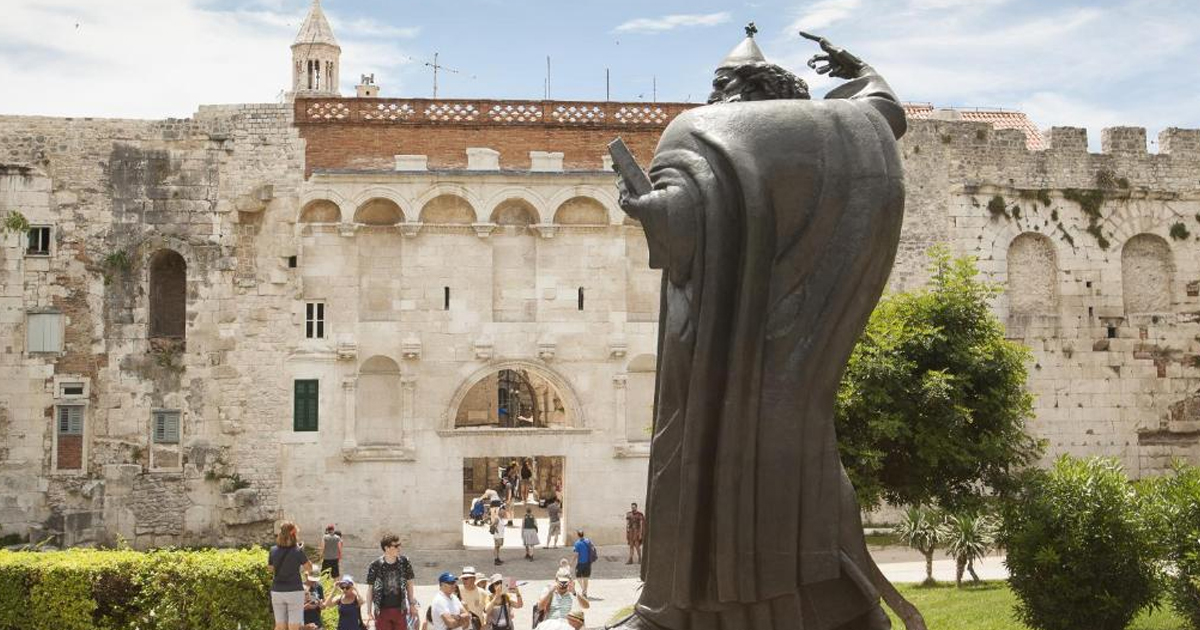
Gregory of Nin’s place in Croatian memory is cemented not only through historical accounts but also through the imposing bronze statue of him in Split, created by famed Croatian sculptor Ivan Meštrović in 1929. Standing over 8 meters tall, the statue depicts Gregory holding a Bible in one hand and gesturing dramatically with the other. His gaze is intense, embodying the defiance and determination that defined his life. Legend has it that rubbing his toe brings good luck, which has made the statue a popular tourist attraction.
In fact, similar statues of Gregory can be found in Nin and Varaždin, illustrating how deeply embedded he is in Croatia’s cultural identity.
Gregory of Nin’s Enduring Legacy
While Gregory of Nin’s direct impact on church policy may have been limited, his symbolic role in Croatian history is profound. He represents the tension between local culture and foreign authority, between a people’s right to their own language and traditions, and the often rigid structures of centralized power.
In modern Croatia, Gregory stands as a national hero, a reminder of the country’s long struggle for self-determination and cultural independence. His story speaks to broader themes of identity, resistance, and the preservation of heritage, themes that continue to resonate in Croatia and beyond.
Today, as visitors gather around Gregory’s statue in Split, touching his worn bronze toe, they are not only connecting with a piece of folklore but also with the deep historical currents of Croatia’s past, currents shaped in part by the defiant bishop of Nin.
Conclusion
Gregory of Nin’s legacy is a powerful reminder of the importance of language and culture in shaping a nation’s identity. His fight to bring the Croatian language into religious services was a battle for more than just words; it was a fight for recognition, for dignity, and for the right to self-expression. Though the church may have resisted his efforts, the Croatian people embraced his message, and Gregory’s name has lived on as a symbol of their resilience and pride.
In a world where local identities are often overshadowed by global forces, Gregory of Nin’s story remains a poignant reminder of the importance of preserving one’s heritage and standing up for what is just.